
Technology plays a vital role in every modern business. Whether you’re a startup launching your first product or a large enterprise managing global operations, maintaining a reliable IT infrastructure is essential for success. However, traditional on-premise systems often come with high costs, ongoing maintenance, and limited flexibility. Purchasing servers, upgrading hardware, and hiring dedicated IT staff can quickly consume a significant portion of your budget.
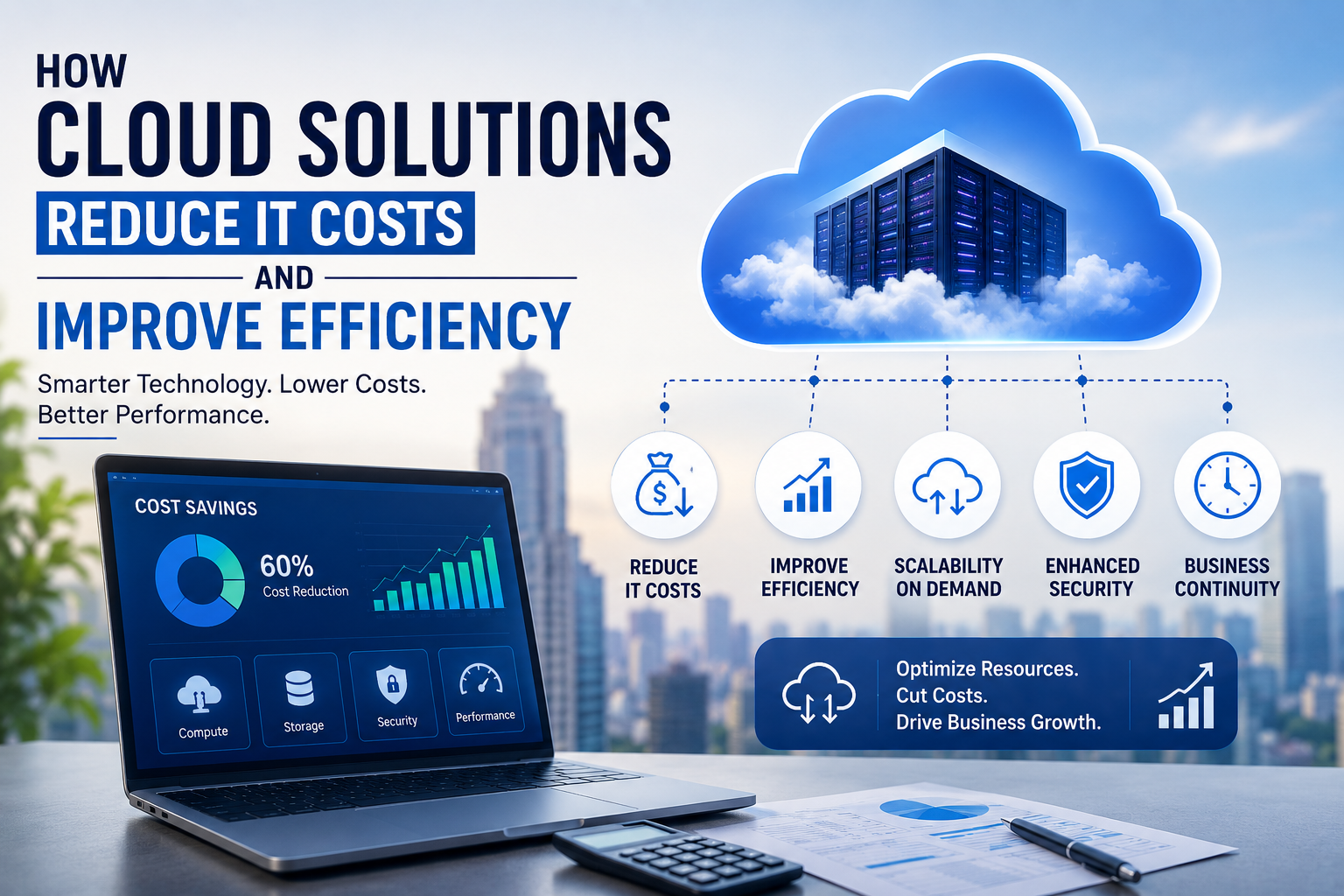
Cloud solutions have transformed the way businesses manage their technology. Instead of investing heavily in physical infrastructure, organizations can access computing resources, storage, and software over the internet while paying only for what they use. This approach not only reduces IT expenses but also improves efficiency, scalability, and business agility.
In this article, we’ll explore how cloud solutions help businesses lower IT costs, streamline operations, and support long-term digital growth.
What Are Cloud Solutions?
Cloud solutions refer to technology services delivered over the internet. These services include computing power, storage, networking, databases, software, and security solutions that businesses can access on demand.
Rather than maintaining expensive on-site infrastructure, organizations rely on cloud service providers to manage the underlying hardware and platforms.
Common cloud services include:
- Cloud storage
- Cloud hosting
- Virtual servers
- Software as a Service (SaaS)
- Cloud backup and disaster recovery
- Cloud security solutions
- Data analytics and AI services
Cloud solutions provide businesses with greater flexibility while minimizing infrastructure complexity.
Why Businesses Are Moving to the Cloud
As organizations grow, their technology requirements become more complex. Traditional IT systems often struggle to keep up with increasing workloads and changing business demands.
Cloud solutions help businesses:
- Reduce infrastructure costs
- Improve operational efficiency
- Scale resources easily
- Increase business flexibility
- Strengthen security
- Support remote work
- Accelerate innovation
These advantages make cloud computing an essential part of modern digital transformation.
How Cloud Solutions Reduce IT Costs
Eliminate Expensive Hardware Investments
Traditional IT infrastructure requires businesses to purchase physical servers, networking equipment, storage devices, and backup systems.
These investments involve:
- High upfront costs
- Installation expenses
- Maintenance fees
- Hardware replacement
- Energy consumption
Cloud solutions eliminate much of this capital expenditure.
Instead of buying hardware, businesses rent cloud resources based on actual usage, significantly reducing initial investment costs.
Pay Only for What You Use
One of the biggest financial advantages of cloud computing is its pay-as-you-go pricing model.
Businesses pay only for:
- Storage used
- Computing resources consumed
- Applications deployed
- Network traffic
This flexible pricing helps organizations avoid paying for unused infrastructure.
Startups especially benefit because they can begin with minimal resources and scale gradually as their business grows.
Lower Maintenance Costs
Managing traditional IT infrastructure requires ongoing maintenance.
Organizations must regularly:
- Update servers
- Replace hardware
- Install security patches
- Monitor systems
- Troubleshoot failures
Cloud providers handle most infrastructure maintenance automatically.
As a result, businesses spend less on IT support while improving system reliability.
Reduce Energy Expenses
Running on-premise data centers consumes significant electricity for powering servers and cooling equipment.
Cloud providers operate highly optimized data centers that achieve greater energy efficiency.
By moving workloads to the cloud, businesses can lower electricity costs and reduce their environmental impact.
How Cloud Solutions Improve Business Efficiency
Faster Deployment
Deploying traditional infrastructure often takes weeks or months.
Cloud solutions allow businesses to launch:
- Virtual servers
- Applications
- Databases
- Development environments
within minutes.
This faster deployment helps organizations respond quickly to changing business requirements.
Easy Scalability
Business workloads constantly change.
Cloud solutions enable organizations to increase or decrease computing resources whenever needed.
For example, businesses can:
- Add storage during peak seasons
- Increase computing power for major projects
- Expand cloud infrastructure as teams grow
This flexibility eliminates the need for expensive hardware upgrades.
Improved Collaboration
Cloud-based applications allow employees to access files and systems securely from anywhere.
Teams can:
- Collaborate in real time
- Share documents instantly
- Work remotely
- Access business applications from multiple devices
Improved collaboration increases productivity while supporting hybrid work environments.
Automatic Software Updates
Cloud service providers continuously update software and infrastructure.
Businesses automatically receive:
- Security patches
- Performance improvements
- New features
- System upgrades
This reduces administrative work while ensuring applications remain secure and up to date.
Better Business Continuity
Unexpected disruptions such as hardware failures, cyberattacks, or natural disasters can interrupt business operations.
Cloud solutions improve business continuity through:
- Automated backups
- Disaster recovery services
- High availability
- Redundant infrastructure
Businesses recover quickly while minimizing downtime.
Enhanced Security Without Higher Costs
Many organizations assume cloud security is expensive.
In reality, leading cloud providers invest billions in security technologies that would be difficult for individual businesses to implement independently.
Cloud security features often include:
- Data encryption
- Identity and Access Management (IAM)
- Multi-factor authentication
- Threat detection
- Continuous monitoring
- Compliance support
Businesses benefit from enterprise-grade security without major infrastructure investments.
Cloud Solutions for Startups
Startups often have limited budgets and rapidly changing requirements.
Cloud computing allows startups to:
- Launch products faster
- Minimize infrastructure costs
- Scale as customer demand grows
- Access advanced technologies
- Reduce operational complexity
Instead of managing servers, startups can focus on innovation and business development.
Cloud Solutions for Enterprises
Large organizations also gain significant advantages from cloud adoption.
Cloud solutions help enterprises:
- Modernize legacy systems
- Improve global collaboration
- Strengthen cybersecurity
- Optimize IT spending
- Accelerate digital transformation
- Support large-scale applications
Cloud platforms provide the flexibility enterprises need to compete in rapidly evolving markets.
Industries Benefiting from Cloud Solutions
Cloud technology supports organizations across nearly every industry.
Healthcare
Healthcare providers securely manage patient records, improve collaboration, and support telemedicine platforms.
Financial Services
Banks and financial institutions process transactions securely while improving scalability and compliance.
Retail and E-commerce
Retail businesses handle seasonal traffic spikes, improve customer experiences, and optimize inventory management.
Logistics
Logistics companies use cloud solutions for shipment tracking, fleet management, and real-time analytics.
Technology Companies
Software companies develop, test, and deploy applications more efficiently using cloud infrastructure.
Best Practices for Cloud Adoption
Businesses planning to adopt cloud solutions should:
- Assess existing IT infrastructure.
- Define business objectives.
- Choose the appropriate cloud platform.
- Implement strong security measures.
- Train employees.
- Monitor cloud performance continuously.
- Optimize cloud usage regularly.
Following these practices ensures a successful cloud migration and long-term operational efficiency.
Why Businesses Choose Kridyx Infotech
Successfully adopting cloud technology requires expertise, strategic planning, and ongoing support.
Kridyx Infotech helps businesses implement secure, scalable, and cost-effective cloud solutions tailored to their operational needs.
The company specializes in:
- Cloud consulting
- Cloud migration services
- Cloud infrastructure management
- DevOps implementation
- Cloud-native application development
- Cloud security solutions
- Custom software development
- Digital transformation services
By understanding each client’s unique business goals, Kridyx Infotech designs cloud strategies that reduce IT costs, improve operational efficiency, and support long-term growth.
Whether you’re a startup moving to the cloud for the first time or an enterprise modernizing legacy infrastructure, Kridyx Infotech provides reliable cloud solutions that help your business stay competitive.
Final Thoughts
Cloud solutions have fundamentally changed how businesses manage technology. By eliminating expensive hardware, reducing maintenance costs, improving scalability, and enhancing collaboration, cloud computing enables organizations to operate more efficiently while lowering overall IT expenses.
Businesses that adopt cloud technology are better positioned to innovate, respond quickly to market changes, and deliver exceptional customer experiences.
Partnering with an experienced technology provider like Kridyx Infotech ensures a smooth cloud journey. With expert guidance, secure cloud infrastructure, and scalable solutions, your business can reduce operational costs, improve efficiency, and build a strong foundation for future digital growth.