
In today’s fast-paced digital world, businesses are expected to release new software features quickly without compromising quality or security. Customers want faster updates, fewer bugs, and reliable applications that work seamlessly across devices. At the same time, companies need to stay competitive by responding quickly to market changes.
Traditional software development methods often create barriers between development and operations teams, leading to communication gaps, delayed releases, and longer development cycles.
This is where DevOps makes a significant difference.
DevOps is more than a technology or a set of tools—it’s a culture that brings development and operations teams together to build, test, and deploy software faster and more efficiently. By embracing DevOps practices, businesses can improve collaboration, automate repetitive tasks, and deliver high-quality software at a much faster pace.
In this guide, we’ll explain what DevOps is, how it works, its benefits, key practices, and why it’s essential for modern software development.
What Is DevOps?
DevOps is a combination of Development (Dev) and Operations (Ops). It is a software development approach that encourages collaboration between software developers, IT operations teams, quality assurance engineers, and security professionals throughout the software lifecycle.
Instead of working in separate departments, these teams collaborate continuously to build, test, deploy, and maintain applications.
The primary goal of DevOps is to deliver software faster while maintaining reliability, security, and performance.
By automating workflows and encouraging continuous improvement, DevOps helps businesses reduce development time and improve software quality.
Why DevOps Is Important
As businesses adopt digital technologies, software development has become increasingly complex.
Applications now require:
- Frequent updates
- High availability
- Strong security
- Faster deployment
- Better customer experiences
Traditional development methods often struggle to meet these demands.
DevOps addresses these challenges by creating a streamlined development process where teams work together and automate repetitive tasks.
As a result, businesses can deliver software updates more frequently and with greater confidence.
How DevOps Works
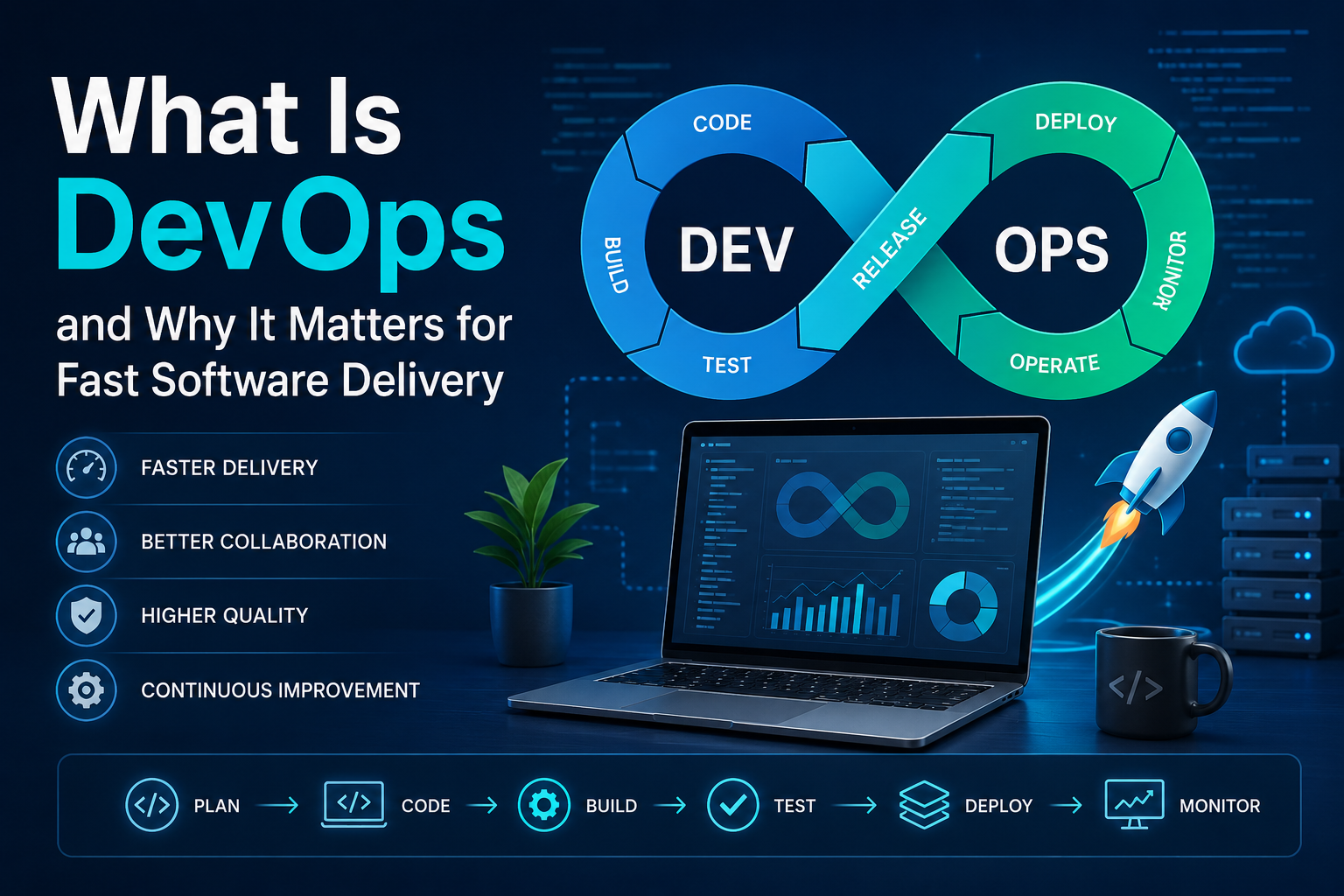
DevOps integrates every stage of software development into a continuous workflow.
The process typically includes:
- Planning
- Development
- Testing
- Integration
- Deployment
- Monitoring
- Maintenance
Each stage is connected through automation and collaboration, reducing manual effort and minimizing errors.
This continuous approach enables businesses to release software updates quickly while maintaining high quality.
Key Benefits of DevOps
Faster Software Delivery
One of the biggest advantages of DevOps is faster software delivery.
Automation speeds up repetitive tasks such as:
- Code integration
- Testing
- Deployment
- Infrastructure setup
As a result, development teams can release updates more frequently without sacrificing quality.
Businesses gain a competitive advantage by responding quickly to customer needs and market trends.
Improved Collaboration
DevOps breaks down communication barriers between development and operations teams.
Instead of working independently, everyone collaborates throughout the project.
This leads to:
- Better communication
- Faster problem-solving
- Improved productivity
- Shared responsibility
Ultimately, stronger collaboration results in better software.
Higher Software Quality
Continuous testing allows developers to identify and fix issues early in the development process.
Rather than discovering problems after deployment, teams can resolve them before customers are affected.
This approach reduces bugs, improves stability, and increases user satisfaction.
Greater Reliability
Automation reduces the risk of human error during deployments.
Standardized deployment processes ensure consistency across environments, making software releases more reliable and predictable.
Businesses experience fewer production issues and reduced downtime.
Enhanced Security
Modern DevOps integrates security practices directly into the development lifecycle.
This approach, often called DevSecOps, includes:
- Automated security testing
- Vulnerability scanning
- Secure code analysis
- Compliance monitoring
By addressing security from the beginning, businesses reduce risks and protect sensitive data.
Core DevOps Practices
Continuous Integration (CI)
Continuous Integration involves regularly merging code changes into a shared repository.
Each update is automatically tested to ensure new code works correctly with existing features.
This helps identify issues early and prevents integration problems.
Continuous Delivery (CD)
Continuous Delivery automates the process of preparing software for release.
Every successful code change moves through testing and deployment pipelines automatically.
Businesses can release new features quickly whenever they’re ready.
Infrastructure as Code (IaC)
Infrastructure as Code allows organizations to manage servers and cloud infrastructure using code instead of manual configuration.
Benefits include:
- Faster infrastructure deployment
- Improved consistency
- Easier scalability
- Reduced configuration errors
Continuous Monitoring
After deployment, applications are continuously monitored for:
- Performance
- Security
- Availability
- Errors
- User activity
Monitoring helps teams detect issues quickly and improve application performance.
Popular DevOps Tools
Although DevOps focuses on culture and processes, several tools help automate workflows.
Common DevOps tools include:
- Jenkins for Continuous Integration
- Docker for containerization
- Kubernetes for container orchestration
- Git for version control
- Terraform for infrastructure automation
- Ansible for configuration management
These tools simplify development and improve deployment efficiency.
DevOps and Cloud Computing
Cloud computing and DevOps work together to accelerate software delivery.
Cloud platforms provide:
- Scalable infrastructure
- Automated deployments
- Flexible resource management
- High availability
When combined with DevOps practices, cloud computing enables businesses to build, test, and deploy applications much faster.
This combination supports modern digital transformation initiatives.
Industries Benefiting from DevOps
Organizations across various industries use DevOps to improve software development.
Healthcare
Healthcare providers deploy secure digital health applications more efficiently while maintaining compliance.
Finance
Financial institutions use DevOps to improve application reliability and strengthen security.
E-commerce
Online retailers release new features quickly, improve website performance, and enhance customer experiences.
Manufacturing
Manufacturers automate production systems and improve operational efficiency through DevOps practices.
Technology Startups
Startups use DevOps to accelerate product launches and scale applications as their businesses grow.
Challenges of Implementing DevOps
Although DevOps offers significant benefits, businesses may encounter challenges during implementation.
Some common obstacles include:
- Resistance to organizational change
- Lack of automation
- Legacy infrastructure
- Skill gaps
- Poor collaboration
These challenges can be overcome with proper planning, employee training, and gradual adoption of DevOps practices.
Best Practices for Successful DevOps Adoption
Businesses can maximize the benefits of DevOps by following these best practices:
- Encourage collaboration across teams
- Automate repetitive tasks
- Implement continuous testing
- Monitor application performance continuously
- Adopt Infrastructure as Code
- Prioritize security throughout development
- Continuously improve development processes
These practices help organizations deliver software faster while maintaining quality and reliability.
Why Businesses Choose Kridyx Infotech
Kridyx Infotech helps businesses modernize their software development lifecycle through comprehensive DevOps solutions.
The company offers expertise in:
- DevOps consulting
- Cloud infrastructure
- CI/CD pipeline implementation
- Infrastructure automation
- Cloud migration
- Custom software development
- Digital transformation services
By combining DevOps best practices with modern cloud technologies, Kridyx Infotech enables organizations to accelerate software delivery, improve operational efficiency, and build scalable digital solutions.
The team works closely with clients to create secure, automated, and reliable development environments that support long-term business growth.
Final Thoughts
DevOps has transformed the way modern software is developed and delivered. By bringing development and operations teams together, automating repetitive tasks, and promoting continuous improvement, DevOps enables businesses to release software faster without compromising quality or security.
Whether you’re building a new application, modernizing existing systems, or scaling your digital operations, adopting DevOps can significantly improve productivity, collaboration, and customer satisfaction.
Partnering with an experienced technology company like Kridyx Infotech ensures a smooth DevOps implementation tailored to your business needs. With the right strategy, tools, and expertise, your organization can accelerate innovation, reduce deployment risks, and stay competitive in an increasingly digital marketplace.